Blog Posts
From Zero to Hero: How to Learn Python Effectively?
January 15, 2026
Python is popular for a good reason. When I first started exploring Python programming, I quickly realized why so many people love it: it's simple to learn, incredibly versatile, and powers everything from data science and web development to automation and AI.
But it's easy to feel overwhelmed with so many tutorials, courses, and resources out there. How do you cut through the noise and learn Python in a way that actually works? I've put together a practical roadmap to help you go step by step and stay focused and motivated. Additionally, I'm hosting a free one-month online workshop for Python basics in January 2026 for participants with no prior programming experience!
Step 1: Understand Why You're Learning Python
Before diving in, ask yourself: What do I want to achieve with Python? Having a clear goal will help you stay motivated and choose the right resources.
-
Data Analysis or Machine Learning? Learn libraries like Pandas, NumPy, and Scikit-learn.
-
Web Development? Focus on frameworks like Flask or Django.
-
Automation? Start with scripting and file handling.
In my case, I started learning Python to work on a machine learning project for severe weather prediction, whereas many of my friends learned Python to prepare for USA Computing Olympiad (USACO).
Step 2: Start with the Basics and Practice Through Small Projects
Begin with the core building blocks. Learning by doing is key. Start with simple projects to reinforce concepts and build confidence, such as a calculator, a to-do list app, or a number guessing game.
Variables and Data Types
Loops and Conditionals
Functions
Lists, Dictionaries, and Tuples
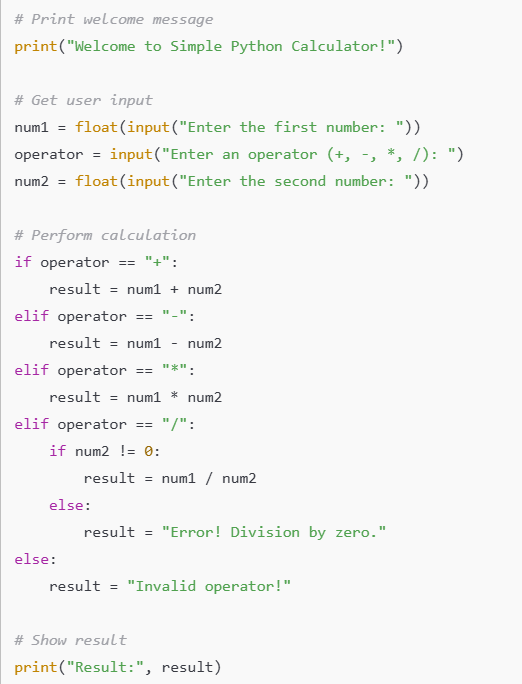
Example mini-project: A beginner-friendly Python calculator that handles addition, subtraction, multiplication, and division, checks for division by zero, and uses simple input and output.
Step 3: Learn to Use Libraries
Python's power lies in its libraries. Depending on your goal, these may be helpful:
Data Science: Pandas, NumPy, Matplotlib
Web Development: Flask, Django
Automation: OS, Requests, BeautifulSoup
Step 4: Build a Bigger Project
Once you've mastered the basics, push yourself further by tackling a larger project. This is where theory turns into real-world application. I built a machine learning model to predict severe weather patterns, which was a challenging but rewarding experience that helped me apply Python to a real- world problem.
My Takeaways
Python is a big world, and becoming truly skilled takes time. The good news? You don't have to do it alone. Take advantage of free resources like open-source projects, ask questions on Stack Overflow, and connect with fellow learners in Python communities on Reddit or Discord. These can accelerate your learning and keep you motivated.